
About
Dermot Goode
From a paralysing fear of public speaking to "the best speaker in his field in the country".

No stranger to public speaking
Dermot Goode is the leading health insurance expert in Ireland. His work includes dealing with the media, radio and television interviews, presenting at corporate conferences and national healthcare events, and speaking to audiences large and small around the country. He has a passion for public speaking and has been described as “the best speaker in his field in the country”.
Public speaking wasn’t always easy for him. As he tells everyone he coaches, it took him years to overcome a total fear of public speaking which at times was paralysing.
A unique feature of his coaching is that he will teach you practical techniques that really work, and, more importantly, show you the ones that don’t. He designed the SUAS (Stand Up And Speak) programme to share his knowledge and experience with everyone who wants to overcome their fear of public speaking.
In the media
Dermot has given many interviews on public speaking, in print and on radio.
Today FM · The Last Word · 10 min
How do you overcome your fear of public speaking?
Dermot and Terry Prone of the Communications Clinic talk to Matt Cooper about where the fear comes from, how Dermot overcame his own, and why being nervous is a good thing.
Read the transcript
Transcript of Today FM’s The Last Word with Matt Cooper. Guests: Terry Prone (the Communications Clinic) and Dermot Goode (SUAS Public Speaking). Machine transcript, lightly edited.
Matt Cooper: According to the Book of Lists, the fear of dying is the seventh greatest fear. The fear of speaking in public is the number one fear of all fears, which may account for the Jerry Seinfeld joke that that means that people at a funeral would rather be in the coffin than be giving the eulogy. Well, how do you overcome your fear of public speaking? Well, we have two people to discuss that with us. First, Terry Prone from the Communications Clinic. Hello, Terry. Is this a major problem that you come across with people who are your clients?
Terry Prone: Oh, I would say that perhaps 10 people a week who come to me are not wanting to be better at public speaking. They want to get over the absolute challenge of having to do it. People like fathers of the bride or somebody in business who has either made a dreadful mistake in a previous speech, you know, had a blank, gone blank, all of that sort of stuff, or is just paralysed at the very thought. And it’s fascinating because people who are not used to public speaking think that people, for example, like me, who does after-dinner speeches and chairing conferences and stuff, that we’re not nervous. And they don’t realise that if you’re not nervous, you’re no bloody good. You have to be nervous. When I’m doing an after-dinner speech, the previous two nights, I would wake up two or three times during the night thinking, I’m worried about something. What am I? Oh, I know what I’m worried about. I’m worried about that speech. But they assume that it’s only them who feels that way. And we shouldn’t forget that even stars have really bad experiences. I mean, Barbra Streisand, for example, did a concert in New York’s Central Park. And she actually forgot the words to not just one, but several songs. And she said afterwards that she wasn’t even cute about it. She was so terrified that she was just horrible. She didn’t sing in public again for 27 years. It can be that crippling, that terrifying.
Matt Cooper: Okay, so how do you deal with this fear? How do you overcome it?
Terry Prone: Can I tell you how not to? Many of the people who pitch up in front of me would take drugs, starting obviously with alcohol, and alcohol, valium, librium, trazodone, and beta blockers. An awful lot of musicians take beta blockers because it stops your hands shaking, zolpidem and anything else that’s handy. And the problem is I actually had a man yesterday who said that he had survived a particularly traumatic one by a particular, what was it, Zoloft. And I had to say to him, yeah, and how do you survive the next one? And he said, well, obviously I’ll take it again. Yeah. And then you’re hooked. And then who’s doing the performance? You, or the Zoloft?
Matt Cooper: Dermot Goode, good evening to you. You’re General Manager of Healthcare Division, at Cornmarket Group, but you’re also from SUAS Public Speaking. What have your own experiences been in relation to public speaking?
Dermot Goode: Yeah, good evening, Matt. Well, I suppose if I go back, I mean, right now, as you say, I’m with Cornmarket. So public speaking now is part of my job. I’m a so-called health insurance expert. So I’m on my feet every day of the week presenting to groups on everything to do with health insurance. But if I go back 25 years or so, I can relate, I think, to everything Terry has said because I had a particular fear of public speaking. I had one bad experience.
Matt Cooper: What was this?
Dermot Goode: Basically, I was just suddenly put on the spot. And suddenly, this overwhelming sensation that you’ve never experienced before, just basically, it’s all consuming. And I actually, I remember telling the teacher at the time, I hadn’t done my work, even though I was looking at it in front of me. And what actually happens then is that the mind takes over, and then you start anticipating all the other events where you might be put on the spot. And as Terry said, for a lot of people, public speaking is alien to us. We don’t like being exposed. We don’t like being up in front of people where you can’t hide. And you actually start anticipating every scenario where it could happen. So I was an expert at avoiding all of those.
Matt Cooper: This sounds a bit unreal to me, because surely, for example, if you’re involved in sports, if you play a bad shot, if you miss an open goal, you go out and you just make sure you don’t miss it the next time. Is it not the same with public speaking?
Dermot Goode: Well, I think, you know, public speaking, a lot of people that I would talk to, public speaking, it’s the fear of failure, the fear of embarrassment. There’s no other scenario like it, because you are up there in front of people. And everything about you, your voice, your sense of dress, the tone of your voice, your pitch, everything is on show.
Matt Cooper: And if you think people are spending that much time looking at your dress, your tone of voice, your appearance, are they that interested in you?
Dermot Goode: Well, you’d be surprised, Matt. You’d be surprised. And for most people, it’s actually the fear of failure. It’s the fear of embarrassment. It’s the fear of maybe doing badly in front of their boss. It’s the fear of letting people down. And it’s that fear. And a lot of it is just irrational. It’s totally irrational.
Terry Prone: But Matt, when you talk about somebody in sport making a mistake and getting over it, you miss the fact that the one thing that is common throughout all of life, for some people, is crippling shyness. And a man named Kagan did fascinating work in the 60s, where he assessed children when they were two years of age. And the children who not just made strange, but really stayed making strange, who were upset by strangers, who didn’t cope with strangers, he tracked them through their life. And he found the shyness continued and it inhibited any possibility of public speaking. And he actually then went further. He went back to babies with video cameras and watched and could catch the babies who got most intimidated by a sudden loud noise. And then, believe it or not, he went into the womb. And he found that babies’ fetuses with a raised heartbeat were more likely to have this crippling shyness. It actually is a major factor for some public speakers. If they then get a humiliating experience, particularly in school, a school teacher can cripple a child.
Matt Cooper: Dermot Goode, how did you conquer your problem?
Dermot Goode: Well, it was funny, actually, I avoided so many scenarios, but a sales job came up that I particularly wanted. And I decided, look, you know, it’s now or never. So I threw my hat in the ring. And against all odds, I got the job. So suddenly, I had a job, I had a fantastic company car. And now I had to basically speak from next week. So I had to confront it.
Matt Cooper: And how did you confront it?
Dermot Goode: Well, what I did initially was I did a phenomenal amount of research. And what I found was that through the research, I found first of all, I wasn’t the only one, because I actually thought just like Terry said, you think all of these people are fantastic speakers, why can’t I be like them? The next thing that I found out, which was a huge, I suppose, breakthrough for me was that I understood exactly why I felt this way physically. So what exactly was happening? So what people mistake to be fear, and panic and phobia, it’s the body’s natural reaction to something it doesn’t like. And then what I actually discovered as well, which is exactly what Terry related to, there are positive stressors, it is good to be nervous. And because it actually brings out the best in you. then I went and I found I eked out programmes, I actually went to one of the programmes run by Terry and go back some years back. And I basically I immersed myself in public speaking. And you know, and I still, I won’t say I’m a fantastic speaker, but I prepare exceptionally well, as Terry mentioned, I do still get nervous.
Matt Cooper: Would you have been nervous before coming into the studio?
Dermot Goode: Absolutely. I mean, it is it is perfectly natural. I think anybody who says I’m not nervous, I would just question that I think they’re on some of the drugs that Terry mentioned. I mean, it is perfectly natural. It’s all about preparation. And the one thing that I say to people is that we all picture us failing, we all worry about the what if scenarios, what I try and do is get people to look at, look, if you prepare properly, then convince yourself you’re going to give a good speech, you’re going to be interesting, you’re going to be timely, you’re going to pitch it properly, you’re going to answer all the questions, and people are going to be left with a positive impression.
Matt Cooper: Terry, can you become overconfident, though? Because are there any things worse than a speech, particularly, you know, sort of at a sporting event or a social event where somebody is so overconfident and thinks they’re funny and they’re not?
Terry Prone: Oh, yes. And the person who starts with a joke that falls completely flat, arrogance in a public speaker is one of the lethal faults. Another lethal fault is where somebody is desperately needy to be loved. And they keep telling self deprecating stories that really show them to be a hero. The point that’s just been made about telling yourself you’re going to be bad. In the early days of building the skyscrapers in New York, the guys who did it best were Native Americans, they could walk on 18 floors up, no bother. But they had a phrase that they used to say to each other, which was, don’t look where you don’t want to go. Don’t keep looking at the ground because it will pull you towards it. I would have, and I’m sure you’ve had the same experience yourself, Dermot, where you have a customer who wants only to focus on what happens if I get a blank, what happens if I dry up. And that’s probably the easiest thing in the world to cope with. And what you have to do is put people through it. But getting people first to realise how good they are at natural communication, my lovely husband maintains that we’re in the transport business. He says, if you get somebody talking 10 minutes, happen to have a camera on and just show them what they’re like when they’re just talking to another human being. Then all they have to realise is bloody hell, I just need to transport that into a situation where there’s more than one human being. And you have to avoid all the bullshit tricks, like pretend the audience is a row of cabbages, pretend they are naked. In my experience, don’t know about you, Dermot, but when I’m terrified of an audience, imagining them naked makes them a lot worse.
Matt Cooper: We will leave it there. Terry Prone from the Communications Clinic, Dermot Goode, from SUAS Public Speaking. Thank you very much for joining us on the programme.
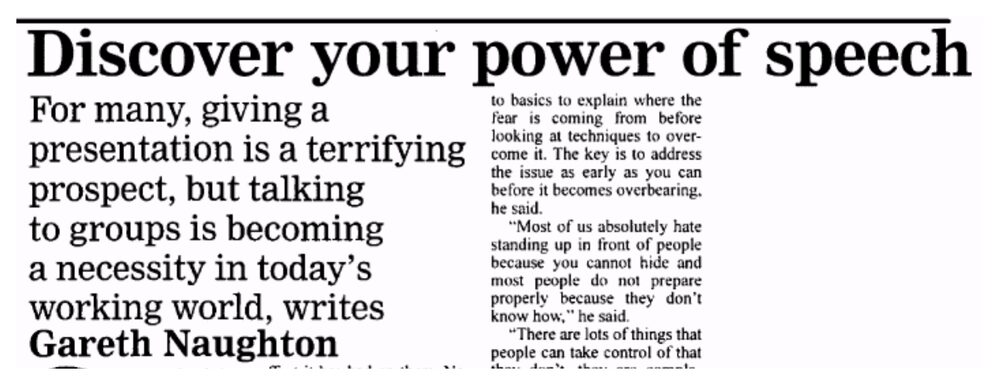
Sunday Business Post · 20 October 2013
Discover your power of speech
By Gareth Naughton
“Sometimes, they are not the best people, but they are just the best guys on their feet.”
A feature on why so many people dread speaking in front of a group. Dermot describes how he overcame his own fear, and why getting people on their feet is the way to beat it.
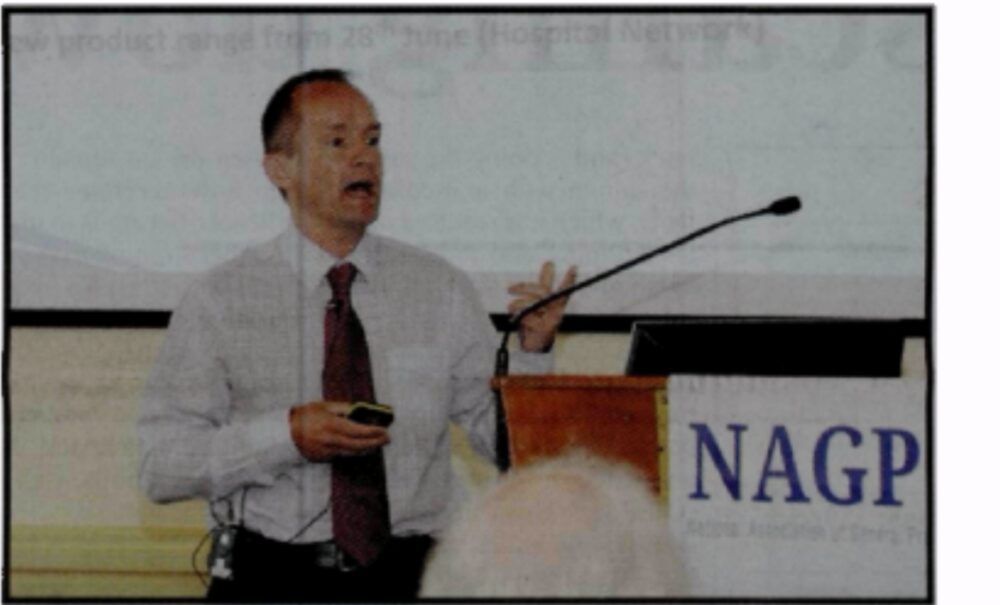
Sunday Business Post · 20 October 2013
Good advice from Dermot Goode
“Think of it like a skill and the more you practice or experiment with it, the better you'll get. Just don't leave it too late to start.”
Dermot's top ten challenges to effective public speaking, from nerves and irrational fears to relying on PowerPoint.
Ready to stand up and speak?
Call Dermot on 086 389 0560 or send a short message, and he will arrange a time that suits you.